Recently, the Australian federal government announced a strategic adjustment to its “Cheaper Home Batteries Program.” This update marks the most significant revision since the program’s launch, not only raising the total budget substantially to 72 billion AUD but also introducing—for the first time—a “capacity-tiered subsidy mechanism.” The new rules will take effect on May 1, 2026.
This policy shift reflects an evolution in the Australian government’s approach to energy storage: moving from an initial strategy of “blanket coverage to stimulate the market” toward “needs-based rational guidance.” The aim is to maximize the overall value of energy storage systems for both the grid and end-users within limited fiscal constraints.
The central change in the new mechanism is the introduction of tiered subsidies tied to storage capacity. The government will no longer subsidize all household storage systems at a uniform rate but will instead set varying levels of support according to capacity brackets.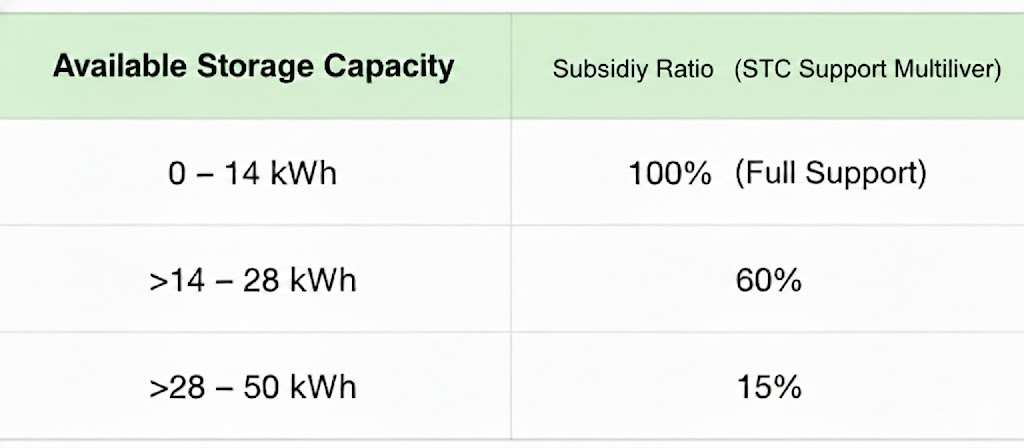
In recent years, under the flat-rate subsidy, some users were inclined to purchase oversized energy storage systems to qualify for higher subsidies, despite those systems often exhibiting low actual utilization. The new tiered mechanism effectively reduces the economic appeal of large-capacity systems, guiding the market back toward a rational, needs-based selection process.
The updated regulations also stipulate that subsidies apply only to the first 50 kWh of usable capacity; any additional capacity will not receive STC support. While small-capacity systems continue to receive strong backing, the marginal benefit of high-capacity systems is curtailed—enabling public funds to reach more households.
This design effectively signals the government’s repositioning of the market structure: it aims to curb household “oversizing,” prevent subsidies from being rapidly absorbed by large systems, extend the reach of limited budgets to more installing households, and steer the industry toward healthy development centered on efficiency and sound structure.
A deeper shift lies in the policy’s redirection of user attention toward system performance rather than mere capacity accumulation. Battery cycle life, charge-discharge efficiency, and photovoltaic (PV) compatibility are now becoming critical considerations in the new wave of home energy storage design.
STC stands for Small-scale Technology Certificate, a standardized instrument used by the Australian government to quantify household renewable energy contributions. Each compliant PV or energy storage system installed earns a certain number of STCs based on its power generation or energy-saving capability.
These certificates can be sold on the open market—typically to energy companies or registered agents—offsetting part of the user’s equipment costs and thus acting as an indirect subsidy.
The “STC multiplier” refers to the weighting factor applied by the government when calculating how many STCs a system qualifies for. A higher multiplier means more STCs, equating to a larger subsidy.
For example, a 10 kWh system with a 100% multiplier would receive 100 STCs. Beyond a certain capacity threshold—such as >28 kWh—the multiplier drops to just 15%, reflecting a sharp reduction in support.
Through this tiered multiplier system, the government channels subsidy funds toward small and medium-capacity installations. This broadens policy coverage while discouraging “oversizing.”
According to targets set by Australia’s Department of Climate Change, Energy, the Environment and Water (DCCEEW):
With a budget more than double that of the previous phase, this expansion signals that the Australian government views household storage as a key component of the future power system. It not only supports distributed generation but can also feed energy back into the grid during peak periods, enhancing system resilience and self-sufficiency.
Furthermore, starting in 2026, the STC multiplier reduction cycle will shorten from one year to six months, aligning more closely with declining storage prices. This means subsidy amounts will adjust dynamically with market conditions—shifting the government’s role from a “fixed subsidizer” to a “dynamic market regulator.”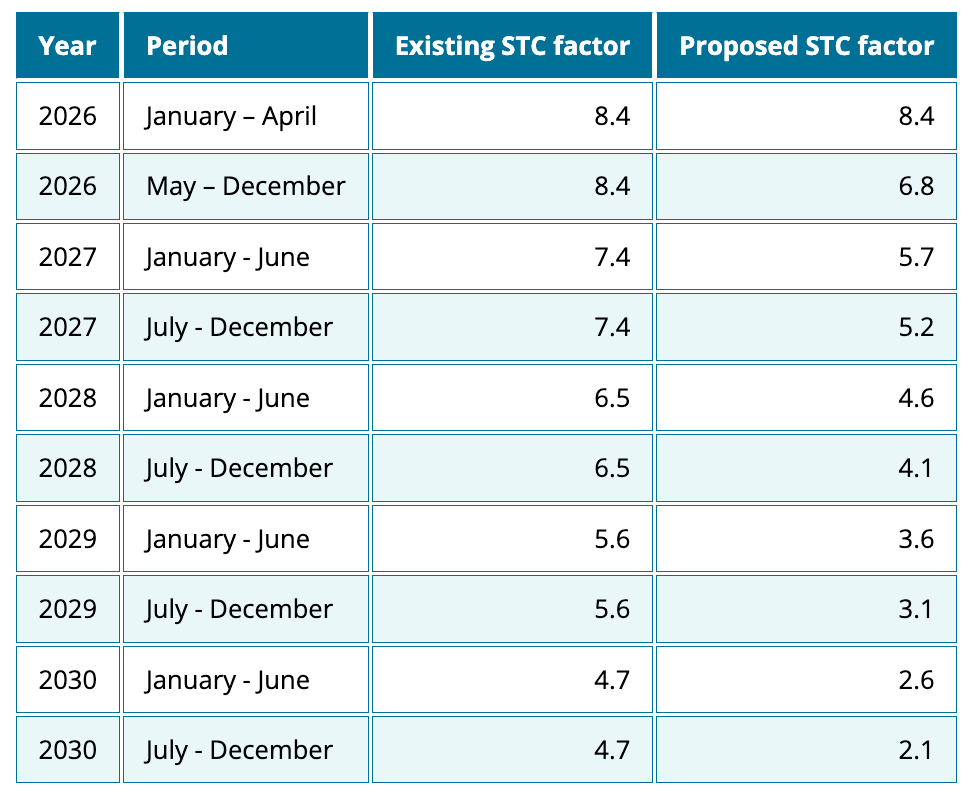
To avoid market disruption, the Australian government has allowed ample lead time: the policy will not take effect until May 1, 2026. For large-capacity storage systems (>20 kWh), this represents a final window of opportunity—after which subsidies could drop by several thousand Australian dollars.
Looking back, Australia’s storage market has undergone classic “policy-driven growth.” While substantial subsidies rapidly expanded market scale, they also led to some disorderly competition and resource misallocation.
Related reading: “23 Billion AUD! 1 Million Installations! Is Australia’s User-Side Energy Storage Entering a Golden Age?”
The current adjustment indicates that policy is entering a more rational phase—prioritizing structural optimization and system efficiency to steer the energy storage industry toward high-quality development. Fiscal support will no longer stimulate the market via fixed sums but will incorporate dynamic coefficient management, shifting the subsidy logic from “broad-brush benefits” to “precision targeting.”


